Chapter 5: Infrastructure including Social Infrastructure
Topics in this chapter
· Infrastructure & Economic Development,
· Energy, Power, Transport system viz., Rail, Road, Civil Aviation,
· Concept of Social Sector & Social Infrastructure,
· Health, Education, Family welfare,
· Development of Health Infrastructure
5.1 INFRASTRUCTURE & ECONOMIC DEVELOPMENT
Infrastructure in India plays a crucial role in accelerating economic development. Infrastructure means the basic physical and organizational structures and facilities that are necessary for a country, city, or organization to function and grow. Infrastructure is the backbone for economic growth.
Good quality infrastructure leads to:
· An increase in a country’s output and productivity.
· The creation of a large number of jobs.
· The efficient circulation of goods and raw materials, which leads to the effective use of scarce resources.
In simple terms, a solid infrastructure helps in producing high-quality goods and services, transporting them to markets, and building essential social institutions like schools and hospitals.
Infrastructure can be categorized in two main ways:
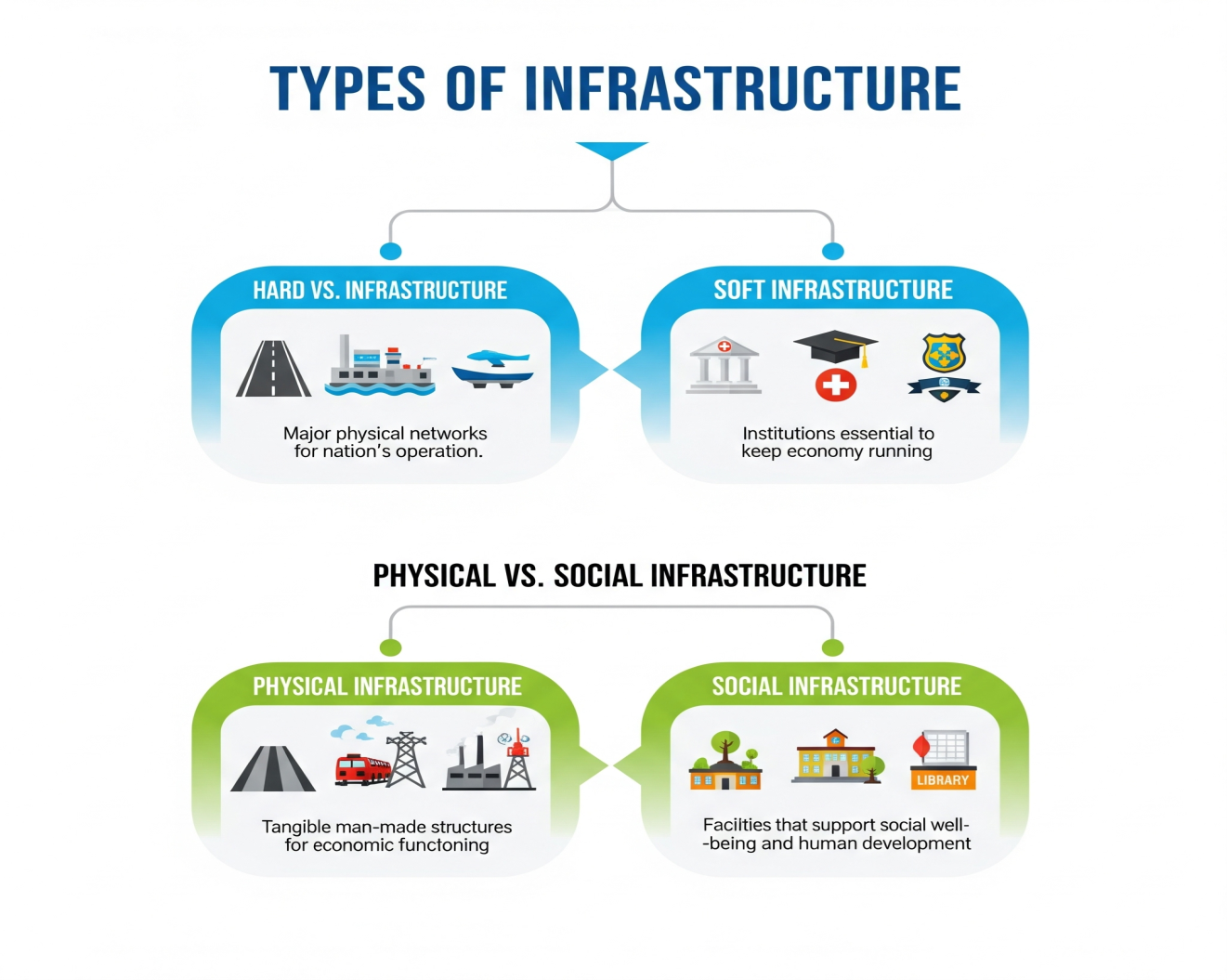
1. Hard vs. Soft Infrastructure:
o Hard Infrastructure: Refers to the major physical networks required for a modern nation to operate. Examples include roads, ports, airports, and pipelines.
o Soft Infrastructure: Refers to the institutions that are essential to keep the economy running. Examples include financial institutions (banks), educational systems, healthcare systems, and law enforcement agencies.
2. Physical vs. Social Infrastructure:
Physical Infrastructure
Physical infrastructure refers to the tangible, man-made structures and networks that are essential for the functioning of a modern economy.
· Examples: Roads, highways, railways, airports, ports, power plants, electricity grids, water pipelines, sewage systems, and telecommunication networks like fibre optic cables and mobile towers.
Social Infrastructure
Social infrastructure refers to the facilities and services that support the social well-being, quality of life, and human development of a population.
· Examples: Schools, colleges, universities, hospitals, clinics, public parks, libraries, community halls, and public housing.
·
5.2 ENERGY, POWER, TRANSPORT SYSTEM, VIZ., RAIL, ROAD, CIVIL AVIATION
Some of the major types of infrastructure are presented below.
Energy Infrastructure
This is the framework that allows for the large-scale transmission of energy from the producer to the consumer. The components of energy infrastructure include:
· Natural gas pipelines, storage, and distribution terminals.
· Petroleum pipelines.
· Specialized facilities for handling coal.
· Renewable energy infrastructure, such as wind power, solar power, hydropower, and biofuel facilities.
Renewable Energy: India’s Initiatives
Renewable energy initiatives are transforming Infrastructure in India.
· Global Leadership: India is a global leader, ranking 4th in overall Renewable Energy (RE) and Wind Power capacity, and has advanced to 3rd in Solar Power capacity.
· Capacity & Targets: Non-fossil fuel capacity has crossed 236 GW, making up nearly 49% of India’s total power. The country is aggressively working towards its ambitious target of 500 GW by 2030.
· Massive Investment: The sector has attracted over $80 billion in investment since 2020, with solar power capacity alone surging past 110 GW.
· Key Policy Focus: Major initiatives include the National Green Hydrogen Mission to create a new energy hub, the PLI scheme to boost domestic manufacturing of solar panels, and the PM Surya Ghar Yojana to rapidly expand rooftop solar installations across the country.
Communications Infrastructure
This includes postal services, telephone networks (including mobile networks), television and radio stations, the internet, and communication satellites. Some government initiatives to boost this sector are:
· 5G Deployed, 6G in Focus: Achieved a rapid nationwide 5G rollout, with strategic focus now shifting to the “Bharat 6G Vision.”
· Rural Broadband Nears Completion: The BharatNet project has provided high-speed fiber connectivity to over 2.1 lakh villages.
· Domestic Manufacturing Boost: The PLI scheme is successfully driving local production of 5G and other telecom equipment.
· Pro-Investment Policies: The telecom sector is supported by a 100% FDI policy and other structural reforms to ensure financial health.
Critical Infrastructure
This refers to the assets on which the broader economy is dependent. It includes:
· Electricity generation and distribution.
· Oil and gas production and transport.
· Telecommunication.
· Water supply.
· Public health (hospitals, ambulances).
· Transportation systems (railways, airports, ports).
· Financial services (banking).
· Security services (police, military).
Transport Infrastructure:
Rail
This includes the national railway network, passenger and freight trains, railway stations, and related infrastructure.
· Network Size: India has an extensive rail system with a total route length of 68,584 km, making it the fourth-largest in the world.
· Total Track Length: Including multiple lines and sidings, there’s over 132,310 km of track.
· Stations & Electrification: The network includes more than 8,000 stations, and as of August 2024, about 64,080 km (roughly 93%) of the routes are electrified (25 kV AC)
Road
This covers the entire network of national highways, expressways, state highways, and rural roads that connect the country. Total Road Length: India boasts over 6,617,100 km of roads—as of December 2024, this is the largest road network globally.
Breakdown by Road Type:
· National Highways: 161,350 km
· Expressways: 6,059 km (access-controlled, high-speed corridors)
· State Highways: 186,528 km
· District/Rural Roads: 5,167,665 km
· Total: 6.7 million km of roads
· Freight & Passenger Usage: Roads carry over 71% of freight and about 85% of passengers within the transport network.
Civil Aviation
This includes airports, airlines, air traffic control systems, and all infrastructure required for air travel.
· Airports & Airstrips: India has a total of 487 airports and airstrips currently in operation, including domestic, international, and other types.
· Airport Types: Among them, there are 35 international and 11 limited-international airports.
Urban Infrastructure
Urban Infrastructure refers to the basic systems and facilities that support the functioning of towns and cities. It includes all the physical and organizational structures that make urban life possible, safe, and efficient. India’s towns and cities generate over two-thirds of the country’s GDP. E.g.- roadways, water distribution, and sewage.
Green Infrastructure
Green Infrastructure refers to a network of natural and semi-natural systems that provide environmental, social, and economic benefits while supporting sustainable development. It focuses on using nature-based solutions to manage urbanization, reduce pollution, conserve resources, and enhance quality of life. Examples include wetlands, wildlife sanctuaries, and conservation projects.
The growth of Infrastructure in India reflects the country’s modernization efforts.
5.3 CONCEPT OF SOCIAL SECTOR & SOCIAL INFRASTRUCTURE
Social Infrastructure in India contributes directly to human capital formation. The social sector includes all areas that contribute to human development, such as health, education, water supply, sanitation, housing, and welfare programs.
Social infrastructure plays a vital role in a country’s economic development and well-being. It is widely acknowledged that education and health have a direct impact on economic growth. Investing in human capital (through education, skill development, and healthcare) increases labor productivity and societal welfare.
During the pre-independence era, the social sector in India was neglected. At the time of independence, the literacy level was just 17%, and life expectancy was only 32.5 years. Today, the country’s literacy rate is 74.04%, and the average life expectancy is around 70 years.
During the pandemic, the government’s expenditure on social services (health, education, and others) increased significantly, reaching nearly 9% of the GDP.
ESG
ESG (Environmental, Social, and Governance) refers to the three most essential factors used to measure the long-term ethical and sustainable impact of a business or an investment. It is considered a modern dimension of corporate social responsibility, and most socially responsible investors use ESG criteria to screen their investments.
5.4 HEALTH, EDUCATION, FAMILY WELFARE
Health and education form the backbone of Social Infrastructure in India.
Health
Healthcare has become one of India’s most important industries, both in terms of income and employment. The Indian healthcare sector is expanding rapidly due to improved coverage, new services, and increased spending by both public and private players.
The COVID-19 pandemic highlighted the weaknesses in social infrastructure and emphasized the need for a strong and resilient health infrastructure.
According to the latest Economic Survey 2024-25, the combined government expenditure on the healthcare sector is estimated to be ₹6.9 lakh crore in the fiscal year 2024-25, which is about 2.2% of the GDP. The 2017 National Health Policy’s aim to increase government health spending to 2.5% of GDP by 2025 remains a key target, with consistent progress being made towards its achievement.
Education
Education is a critical factor in any country’s economic development and is a fundamental right in India. The Constitution (Eighty-sixth Amendment) Act of 2002 made free and compulsory education for all children aged six to fourteen years a Fundamental Right (Article 21-A).
According to the Economic Survey 2024-25, the combined government spending in the education sector is estimated to be ₹8.5 lakh crore for 2024-25, which is about 2.9% of the GDP. The government is implementing the landmark National Education Policy (NEP) 2020, which replaced the 34-year-old policy from 1986. As part of the NEP, the old 10+2 structure is being replaced by a 5+3+3+4 curricular framework, and its implementation is now in an advanced stage across the country.
Family Welfare
The primary goal of the Family Welfare programme is to stabilize the population and provide high-quality health services. In 1952, India became the first country in the world to implement a National Programme for Family Planning. The program aims to provide integrated Maternal and Child Health (MCH) services, improve awareness through effective communication, and ensure easy and convenient access to Family Welfare services free of cost.
Government expenditure has strengthened Infrastructure in India in recent years.
Government Expenditure on Social Services (Centre and States combined)
Item | 2014-15 | 2015-16 | 2016-17 | 2017-18 | 2018-19 | 2019-20 | 2020-21 | 2021-22 | 2022-23 | 2023-24 (RE) | 2024-25 (BE) |
As percentage to GDP | |||||||||||
Expenditure on Social Services | 6.2% | 6.6% | 6.7% | 6.6% | 6.2% | 7.5% | 8.6% | 8.3% | 8.4% | 8.1% | 8.2% |
i) Education | 2.8% | 2.8% | 2.8% | 2.8% | 2.8% | 3.0% | 2.9% | 2.9% | 2.9% | 2.8% | 2.9% |
ii) Health | 1.2% | 1.3% | 1.4% | 1.4% | 1.4% | 1.5% | 2.1% | 2.1% | 2.2% | 2.1% | 2.2% |
iii) Others | 2.2% | 2.5% | 2.5% | 2.4% | 2.0% | 3.0% | 3.6% | 3.3% | 3.3% | 3.2% | 3.1% |
As percentage to total expenditure | |||||||||||
Expenditure on Social Services | 23.4% | 24.3% | 24.4% | 25.2% | 23.1% | 24.8% | 26.5% | 26.4% | 25.8% | 25.5% | 25.7% |
i) Education | 10.8% | 10.4% | 10.2% | 10.7% | 10.4% | 9.8% | 9.0% | 9.2% | 8.9% | 8.8% | 9.0% |
ii) Health | 4.5% | 4.7% | 5.0% | 5.4% | 5.3% | 5.0% | 6.5% | 6.7% | 6.8% | 6.6% | 6.8% |
iii) Others | 8.1% | 9.3% | 9.2% | 9.1% | 7.4% | 10.0% | 11.0% | 10.5% | 10.1% | 10.1% | 9.9% |
Note: Data for 2020-21 and 2021-22 has been updated with actual figures. RE: Revised Estimates, BE: Budget Estimates. Totals may not exactly add up due to rounding.
Source: Compiled from the Economic Survey 2024-25 and Union Budget 2025-26.
5.5 DEVELOPMENT OF HEALTH INFRASTRUCTURE
Health infrastructure refers to the essential services and structures that contribute to public health. It is a key metric for assessing a country’s healthcare policy. Inadequacies in healthcare infrastructure limit access to services and contribute to poor quality of care, especially among underprivileged communities.
The five basic areas of health infrastructure are:
1. Skilled labor (doctors, nurses).
2. Integrated electronic information systems.
3. Public health agencies.
4. Resources (hospitals, clinics, equipment).
5. Research.
India’s health infrastructure faces challenges like inadequate financial resources, poor facilities, and a lack of efficient personnel.
To address these challenges, the government has launched several major initiatives:
· Ayushman Bharat Pradhan Mantri Jan Arogya Yojana (AB PM-JAY): This is the world’s largest government-funded health assurance scheme.
- Objective: To provide a health cover of ₹5 lakh per family per year for secondary and tertiary care hospitalization to over 12 crore poor and vulnerable families.
- Status (Aug 2025): The scheme has been a resounding success, with over 38 crore Ayushman cards issued. It has authorized more than 7.5 crore hospital admissions, providing crucial financial protection and access to quality healthcare.
Ayushman Arogya Mandir (formerly Health and Wellness Centres): This initiative is strengthening primary healthcare by upgrading Sub-Health Centres and Primary Health Centres into Ayushman Arogya Mandirs (AAMs).
- Objective: To provide comprehensive primary healthcare, including screening for non-communicable diseases, wellness activities, and free essential drugs and diagnostics, closer to communities.
- Status (Aug 2025): Over 1.70 lakh such centres have been established and are operational across the country, significantly improving access to primary care and reducing the burden on hospitals.
PM-Ayushman Bharat Health Infrastructure Mission (PM-ABHIM): This is the largest pan-India scheme launched since 2005 aimed at strengthening public health infrastructure from the grassroots up.
- Objective: To fill critical gaps in the public health system, particularly in primary and critical care, and to build up the capacity for disease surveillance and response.
- Status (Aug 2025): The mission is in an advanced stage of implementation, with significant progress in establishing critical care hospital blocks in over 600 districts and strengthening the network of public health labs and diagnostic services.
Ayushman Bharat Digital Mission (ABDM): This mission is creating a seamless online platform to integrate the country’s fragmented digital health infrastructure.
- Objective: To provide every citizen with a unique Ayushman Bharat Health Account (ABHA) number, connecting them to their digital health records and enabling interoperability between different healthcare providers.
- Status (Aug 2025): The mission has gained significant traction, with over 60 crore ABHA IDs created. The Unified Health Interface (UHI) is now enabling services like teleconsultation and lab report access through a unified network.
 Click below to download the full PDF study material for this chapter:
 Download This Chapter’s PDF